| Taxonomy: |
|
| Kingdom: |
Animalia |
| Phylum: |
Chordata |
| Class: |
Reptilia |
| Order: |
Squamata |
| Sub-Order: |
Sauria |
| Family: |
Gekkonidae |
| Genus: |
Stenodactylus |
| Species: |
petrii |
| Year: |
- |
| Distribution: |
Nnorthern Africa and Israel. |
Diet: Crickets, Phoenix Worms, and Meal
Worms. Make sure to dust the insects with a multi-vitamin
supplement every 4th to 5th feeding as they will
not get the natural vitamins they would from a diverse
diet in the wild. If offered multi-vitamin supplements
too often, in one to two year time they will develop
Kidney Stones and die.
Adult size: From head to base of tail, they
are about 2- 3 inches long. The tails are quite
long, compared to their size, 1- 2 inches. If a
tail gets dropped, it will grow back, but will be
shorter and stubbier.
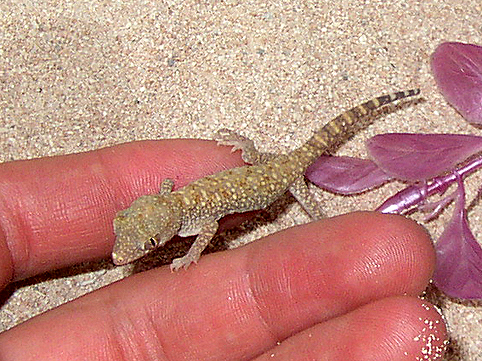
Dune geckos are a very small type of geckos. They
are full of character and it’s amazing to
watch them feeding. They are mostly nocturnal. They
have interesting frog-like eyes, which earned them
a common name "frog-eyed gecko". Unlike
most other geckos, these can't climb up smooth surfaces.
Instead, they prefer to dig. During day time, they
prefer to hide in caves or dark places, though some
times they have being seen active during this time
as well. This is a hardy species, but because of
their small size and being quite fast, it’s
best not to handle them. They should be kept at
75- 85*F during day time and 65- 75*F during night.
They should be provided a basking spot with a regular
heat light as a UVB light is not required for geckos
as they digest their food in different ways, unlike
other lizards. Dune geckos because of their small
feet and finger size, can't be put on any heat rocks
or heat pads as Dune Geckos are most likely to get
burns from them.
|





 California King Snakes
  today!